Spore Syringes vs Liquid Culture: What’s the Difference?
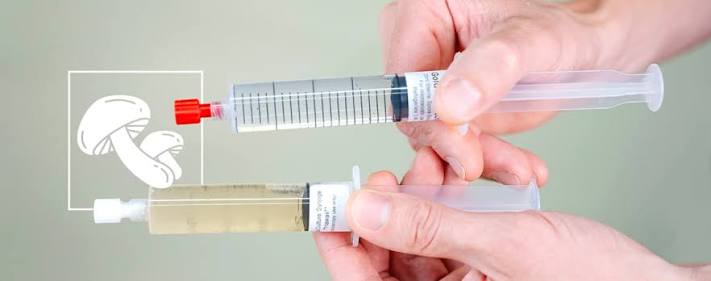
If you’re getting into the world of mycology, two terms you’ll quickly encounter are spore syringes and liquid culture. At first glance, they look almost identical: clear syringes filled with liquid and something fungal floating around inside.
But biologically, they’re very different.
Understanding that difference is one of the fundamentals of mycology, so let’s break it down without turning this into a university lecture on fungal genetics.
What Is a Spore Syringe?
A spore syringe contains microscopic fungal spores suspended in sterile water. Spores are essentially the reproductive cells of fungi — somewhat comparable to seeds in plants, although fungi would probably object to the comparison.
Because spores contain genetic material rather than established mycelium, they’re particularly useful for microscopy, taxonomy, identification and educational research.
Under a microscope, researchers can examine characteristics such as:
- Spore shape and size
- Colour and pigmentation
- Surface texture
- Structural differences between species
One interesting feature of spores is genetic variation. When compatible spores germinate, they can produce genetically unique mycelium. This means spores are useful for studying fungal genetics and variation within a species.
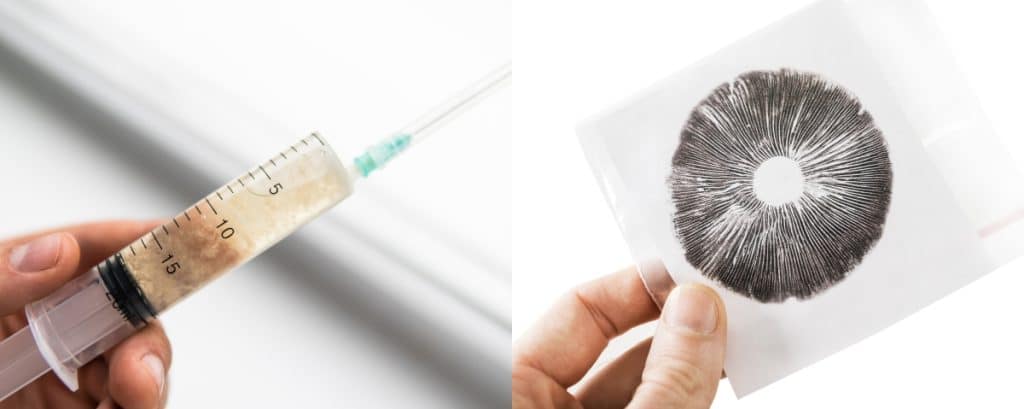
Spore syringes are typically made by collecting spores from a spore print and suspending them in sterile water.
Interested in buying your own Spore Syringes? Mycomind offers a wide range of strains you can choose from. There is also a range of Spore Prints for those who want to make their own spore syringes.
What Is Liquid Culture?
Liquid culture is different because it contains living mycelium suspended in a nutrient-rich liquid solution, commonly containing water and a source of carbohydrates.
Mycelium is the vegetative network of a fungus — the mass of microscopic, thread-like structures known as hyphae that eventually forms the larger fungal organism.
Instead of starting with dormant reproductive spores, liquid culture contains fungal tissue that is already actively growing.
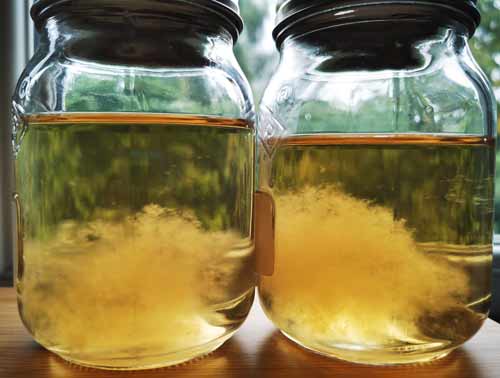
This is why LC often appears cloudy or contains visible wispy strands of mycelium floating through the solution.
Spore Syringe vs Liquid Culture
The easiest way to remember the difference is:
Spore syringe = spores
Liquid culture = living mycelium
Spore syringes are especially valuable for microscopy and taxonomy because the spores themselves can be examined and compared. They also contain greater genetic diversity.
Liquid cultures, meanwhile, contain an already-established fungal culture. If produced from an isolated culture, they can offer much greater genetic consistency, making them useful for maintaining and studying particular fungal genetics.
Another important difference is storage. Spores are naturally designed to survive periods of dormancy, while living mycelium remains biologically active and generally requires more careful storage and handling.
Which One Is Better?
Neither is universally “better” — they simply serve different purposes.
If your interest is microscopy, spore identification, taxonomy or genetic diversity, spore syringes are usually the more relevant research material.
If your interest involves studying established fungal cultures, mycelial characteristics or preserving specific genetics, liquid culture may be more appropriate.
Think of it this way: spores are where the fungal story begins, while liquid culture is the story already underway.
And considering fungi have been doing their thing for hundreds of millions of years, it’s a pretty good story to start exploring.

Curious to learn more about fungi? Explore our extensive Mushroom Growing Guide, browse beginner-friendly Mushroom Grow Kits, or discover the fascinating world of fungi through our growing library of cultivation and foraging resources.
Thanks for reading, and I hope you found this guide helpful. At MycoMind, we're passionate about making mushroom growing, foraging, and fungi education accessible to every Australian.